Tags


18 Saturday Oct 2025
Posted in Gibraltar
Tags
19 Friday Aug 2016
Posted in Gibraltar, Memoirs of Gibraltar, ROYAL NAVY, travel
Tags
I don’t know about other people but whenever trauma comes into my life my mind tends to automatically block it out and then go into a practical mode to manage it like some sort of safety mechanism; as a result my memories of Carol being in hospital for six weeks are very sketchy. Having said that perhaps the one thing that does resonate all these years later was how much Carol trusted and liked her consultant Colonel Price; she would often say he listened to all of her concerns and gave her all the time she needed to express them. What is probably more clear to me (hopefully without coming across too selfish) are the things I needed to cope with as a result of being on my own with the children during that time.
*
One thing I definitely felt was that the Navy were only supportive to a point; they wanted me back at work quick smart and as fast as possible. I was allowed a certain amount of leave but was given no choice about having to make arrangements for the children in the best way I could by asking friends and the Naval Wives Club for help and I totally hated that; mainly because I was terrified the children wouldn’t cope very well because so many different people ended up being involved in their care. Also my own history of having been brought up in care didn’t help either.
*
Facing the attitude of “either you make arrangements for your children or we will” left me feeling totally disempowered and beholding to virtual strangers; it was reminiscent of the last time my family needed me (when Sam was seriously ill and almost died but they wouldn’t allow me home). The pattern that was emerging was one I found frightening. Since putting in my 18 month notice to leave the RN I did think that there may be times when I questioned my decision – or even reversed it – but that was becoming increasingly unlikely.
*
I suppose the fact I didn’t go into meltdown could be credited to the Royal Navy (for giving me the skills to manage traumatic situations) although in hindsight I did see it as something of a paradox because to my mind they created the crisis in the first place.
My days evolved into taking the children ‘somewhere’ for their day, going to work (and worrying about them all day at the same time I worried about Carol all day), collecting the children after work, taking them to see their Mum – or arranging a baby-sitter at times I went on my own – and finally getting home for bedtime routines with the children before flaking out myself.
*
This attitude of the Navy’s regarding compassionate situations wasn’t anything new to me; a situation from my distant past was also informing my responses. Before I ever met Carol I was abroad when the Navy flew me home from Mombasa because my foster dad Billy had had three strokes and been taken into Mansfield hospital. However when I got back to UK my foster Mam Katie had been taken into Nottingham hospital for an operation. Whilst in UK I found myself travelling from home to two separate hospitals twice a day which was exhausting physically and emotionally; the situation became worse because my Mam died and I wasn’t allowed to tell my dad in case he had another stroke.
*
When I didn’t return to my ship on the expected date the heavies were sent around to my house. Eventually I was given an extra two weeks leave and ordered to return to my ship which by then was in Singapore. Inside those two weeks I buried my Mam, sold everything my parents had owned, banked the money for dad and gave up the lease on their rented house. After arriving in Singapore I was punished for being late; it wasn’t long after that I began hitting the bottle. Although this tale is from one of my other memoirs (Memoirs of a Sailor – which I’ve currently placed on pause to write this one) I’ve included it because I’ve felt it is relevant.
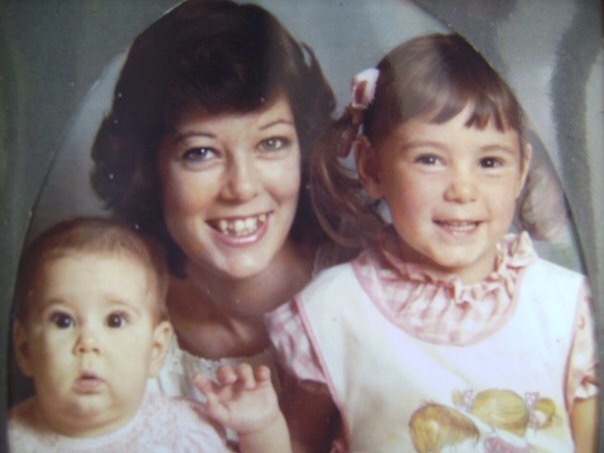
(My beautiful family. Carol with the children in their pink and white frocks before their sister arrived)
*
Throughout the duration of Carol’s pregnancy I had decided (almost decreed) we would be having another daughter and so while she was in hospital I tripped off down Irish Town where I knew a lady who made children’s clothes kept her little shop. I explained to the lady that our new daughter would be arriving soon and asked her if she would make her frock in pink and white with embroidery on to match frocks that her sisters had. Duly the lovely lady made the frock which was beautiful and for which she charged me a very reasonable £4. When I told Carol she said ‘Why do you keep thinking its a girl, what if it isn’t?’. I don’t know how I knew. But I knew.
*
After six weeks in hospital Carol eventually came home and between then and when the baby arrived there were a couple of false alarms which naturally sent me into panic mode. Then on the one day I decided to think ‘yeah, yeah’ and turn over to go back to sleep it turned out to be the real thing!!! When it finally got through my thick head that ‘this was it’ I sorted the transport and we just got to RNH in time; Carol was rocking so much in labour that she almost gave birth in the lift. Literally as we got into the delivery suite our daughter Benita arrived. Our family was complete 🙂
*
10 Sunday Jul 2016
Posted in Gibraltar, Memoirs of Gibraltar, ROYAL NAVY, travel
There’s something (a lot of people feel is) quite attractive, even romantic at times, about living in a caravan which probably stems from images and stories of New Age travellers, Romany Gypsies and others who either choose, or inherit, one of those alternative lifestyles. For people who are stuck in a ‘normal’ life working five days a week and with a mortgage and bills to pay it can almost be seen as utopia. We didn’t exactly have the ‘no bills’ bit but we did have that alternative Bohemian lifestyle for a few months and though it had its ups and downs they were very special days.
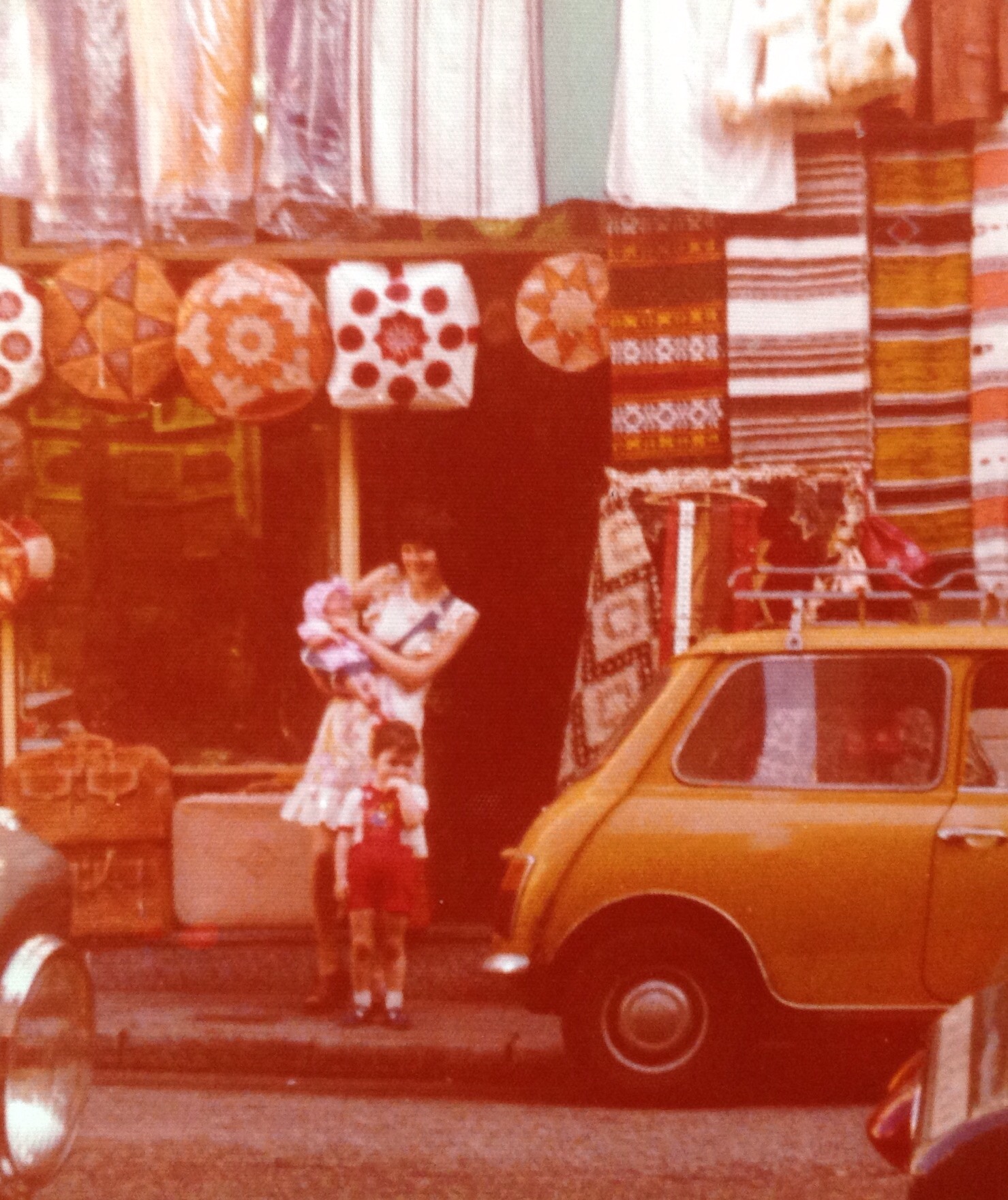
(Carol on Main Street with the children. Accessing the shops was now easier from the caravan).
*
I think to a certain degree we felt some of those lovely sentiments; it was a very close and cosy lifestyle which is exactly what we needed at that time (after our separation); there was also (naturally) less housework to do (than in a bigger living space) leaving far more time for leisure and recreation. My morning walks to work at HMS Rooke in the sunshine are still very much ingrained in my positive memory bank as is the relaxed laid back culture which allowed Carol to call in at my office in Rooke on her way back from the NAAFI with a tasty snack for me. Carol, too, found popping up to Main Street was far less arduous and more often a nice experience.
*
In parallel with the good bits though there were downsides which (in the main) Carol had to cope with. One was a lack of space for clothes, prams, toys, uniforms and a million other things. With four people in a small space she had to think twice before (for example) getting an ironing board out. Precision planning became essential and this was particularly highlighted at bath time; the caravan site had communal bathrooms and so people had to sort of book slots to use the facilities.
*
On the subject of the communal bathrooms there was actually two, each equipped with a bath, a sink and a toilet. Often, once the children had been bathed, I would have them in the caravan while Carol popped over to the bathrooms to have her own bath.
*
On one particular evening Carol was late going over to the bathrooms (we’d obviously been out somewhere) and it was quite dark. Entering one of the bathrooms she turned on the light to find there was no plug in the bath and so went next door to get the plug out of the other bathroom. When she went into the second bathroom and pulled the light cord she found the light wasn’t working as the bulb had blown. Knowingly roughly where the bath was and at which end the plug would be Carol made her way into the room and stuck her hand in the bath to fish out the plug…
Thirty yards away (in the caravan with with the children) all I heard was a blood curdling scream. I shot over to the bathrooms to find Carol the darkened bathroom frozen in fear. Realising the light bulb had blown I ran and got the bulb from the bathroom next door and turned on the light. There then followed….another blood curdling scream.
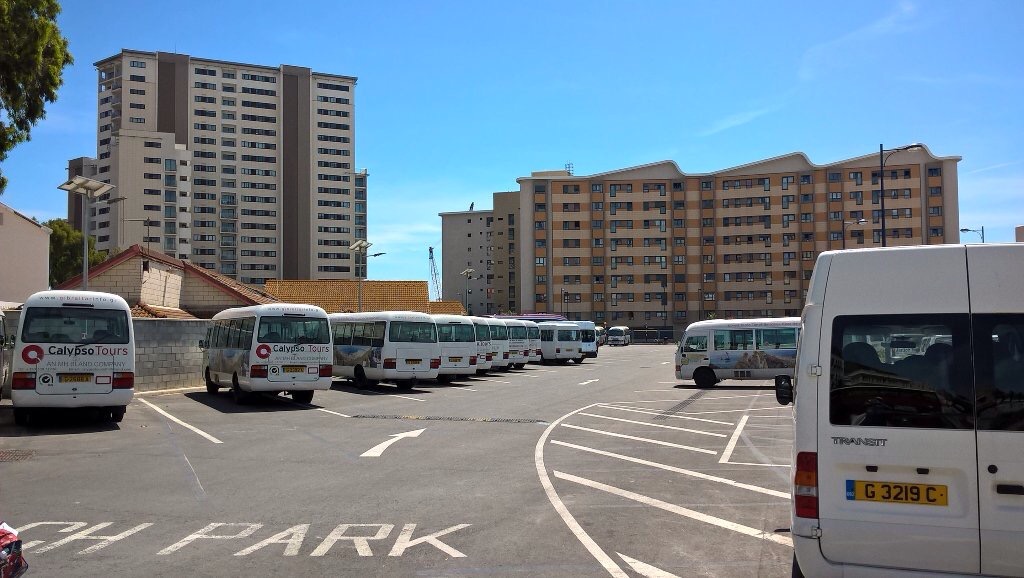
(When I went looking for where the Naval caravan site used to be on Queensway I found a bus terminal. 2016)
*
When Carol put her hand in the bath (in the dark) to fish out the plug, what she had done was stick her hand into a six inch deep colony of cockroaches (affectionately known as Bombay Runners – but please don’t ask me to explain why they are called that). It appeared the bath is where they slept, mated or did whatever when the lights were low.
I’m not someone who would go out of my way to share my space with these creatures but having spent a long time in the Far East I was sort of used to them being around. Carol on the other hand was pathologically terrified of them and between this incident and the last (on her first night in Gibraltar in the lobby of Trafalgar House) the experiences were life changing.
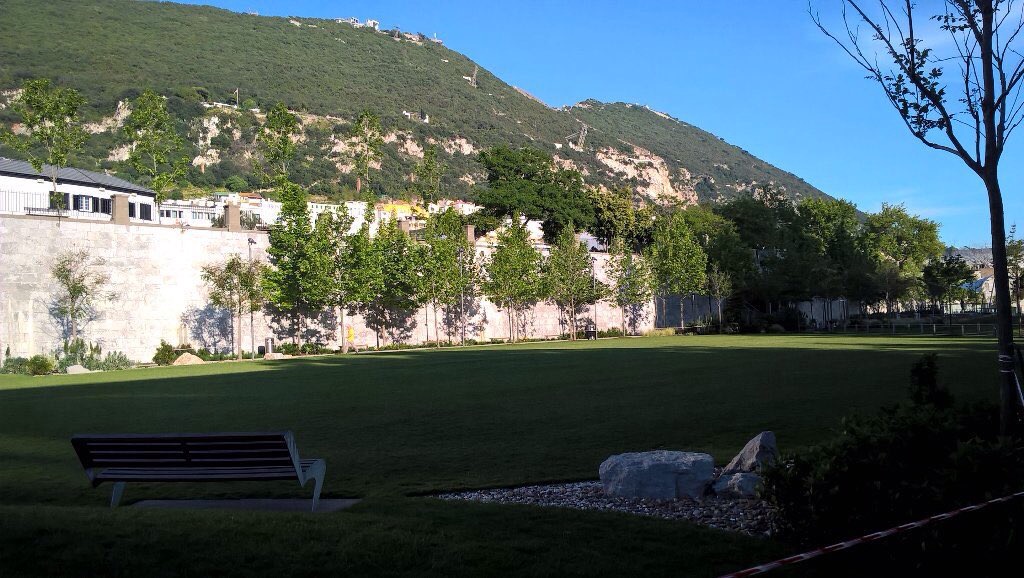
(Virtually opposite where the caravan site was is now the beautiful Commonwealth Park).
*
It took me a long time to move her psyche from ‘I want to go home to UK NOW!!!’ to ‘I’ll stay but you better check everywhere they might be before I go in or you’re dead’. Somehow I managed to achieve the latter because our stay in Gibraltar didn’t end for some considerable time. (And I’m not dead 🙂 )
09 Saturday Jul 2016
Posted in Gibraltar, Memoirs of Gibraltar, monarch airlines, ROYAL NAVY, travel, tripadvisor
It’s sometimes really hard for me to remember things from so long ago and then write them down in the right order so please do bear with me if continuity is compromised occasionally. 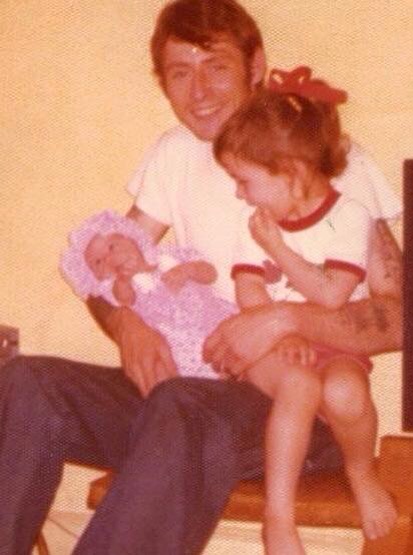
(At Trafalgar House with the children)
*
Part of the problem I guess is that (yes) I am an old fart and so the white cells aren’t as sharp as they once were. But another challenge I have is that I write in real time (by which I mean my blogs aren’t planned or prepared. I literally just sit down for an hour every day with my iPad and even I don’t know what I’m going to write about until I start. For me that’s the real essence of a memoir in that it becomes a collection of thoughts and anecdotes rather than a story; it’s also a very cathartic experience for me in that for that hour every day I am in (my beloved) Gibraltar. (I doubt if I could write a real story to save my life). Anyways, that said…on we go.
*
Our leisure time in Gibraltar was always going to be lovely for us all because there is always somewhere different to go, something different to do and it truly is a wonderful place to raise little children; I’m so convinced of that there are times I think I should have worked for the Gibraltar Tourist Board. (Oh, in case you missed it in previous posts – I ‘loved’ being a young Daddy).
However, as well as the fun days there was also practicalities to consider such as balancing my job with our family life. Although our flat at Trafalgar House was lovely with its views over Alameda Gardens it was always a challenge for Carol when I wasn’t there to get in and out with the children, the buggy and all the paraphernalia that goes with that.
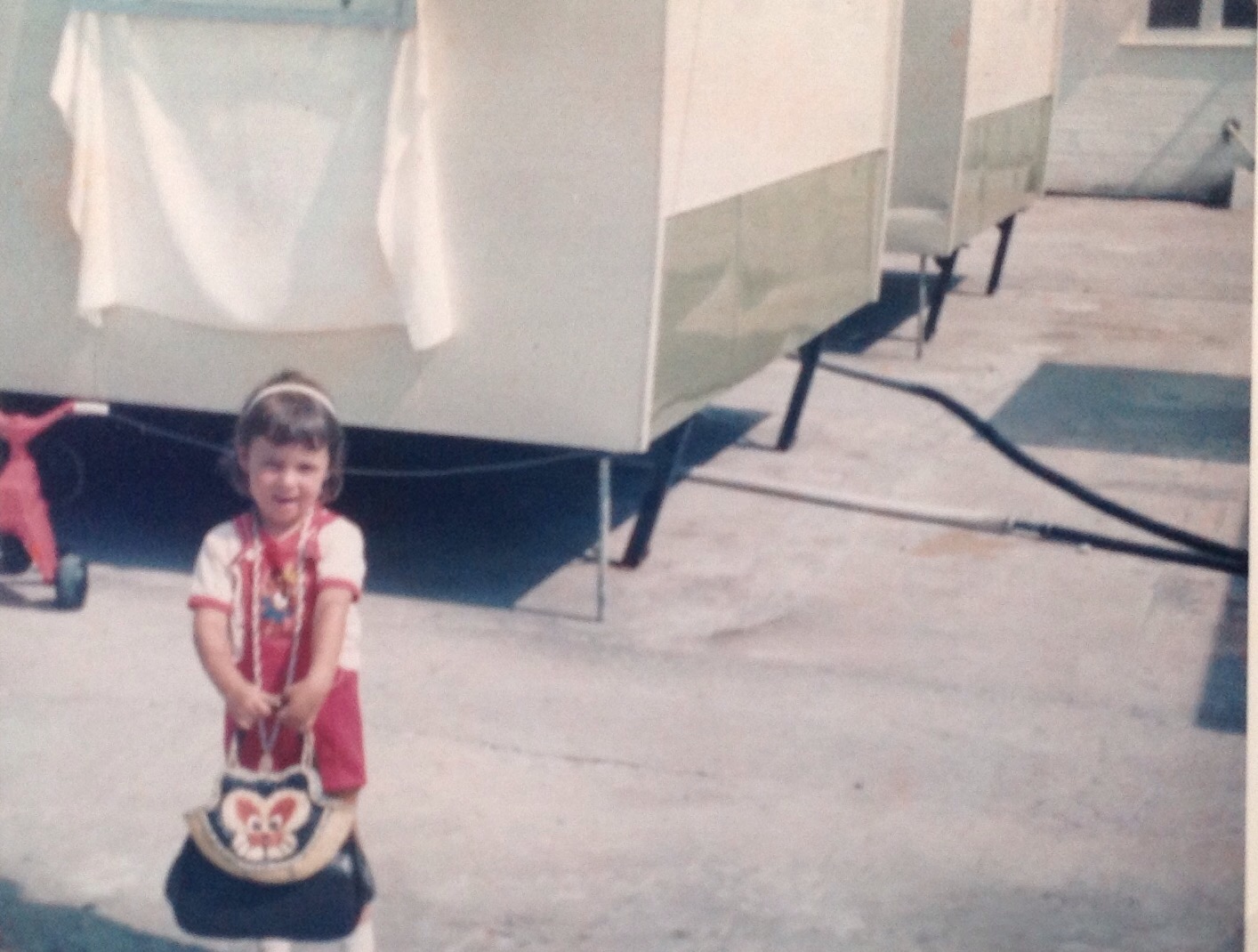
(Tracey playing outside our caravan)
*
((It’s worth making a note here that the seventies was a very sexist period in time; in UK I remember waiting at a bus stop on my own with our (3) children and when the bus arrived several people got off to help me on – Carol in the same situation would often be ignored or left to struggle on her own)).
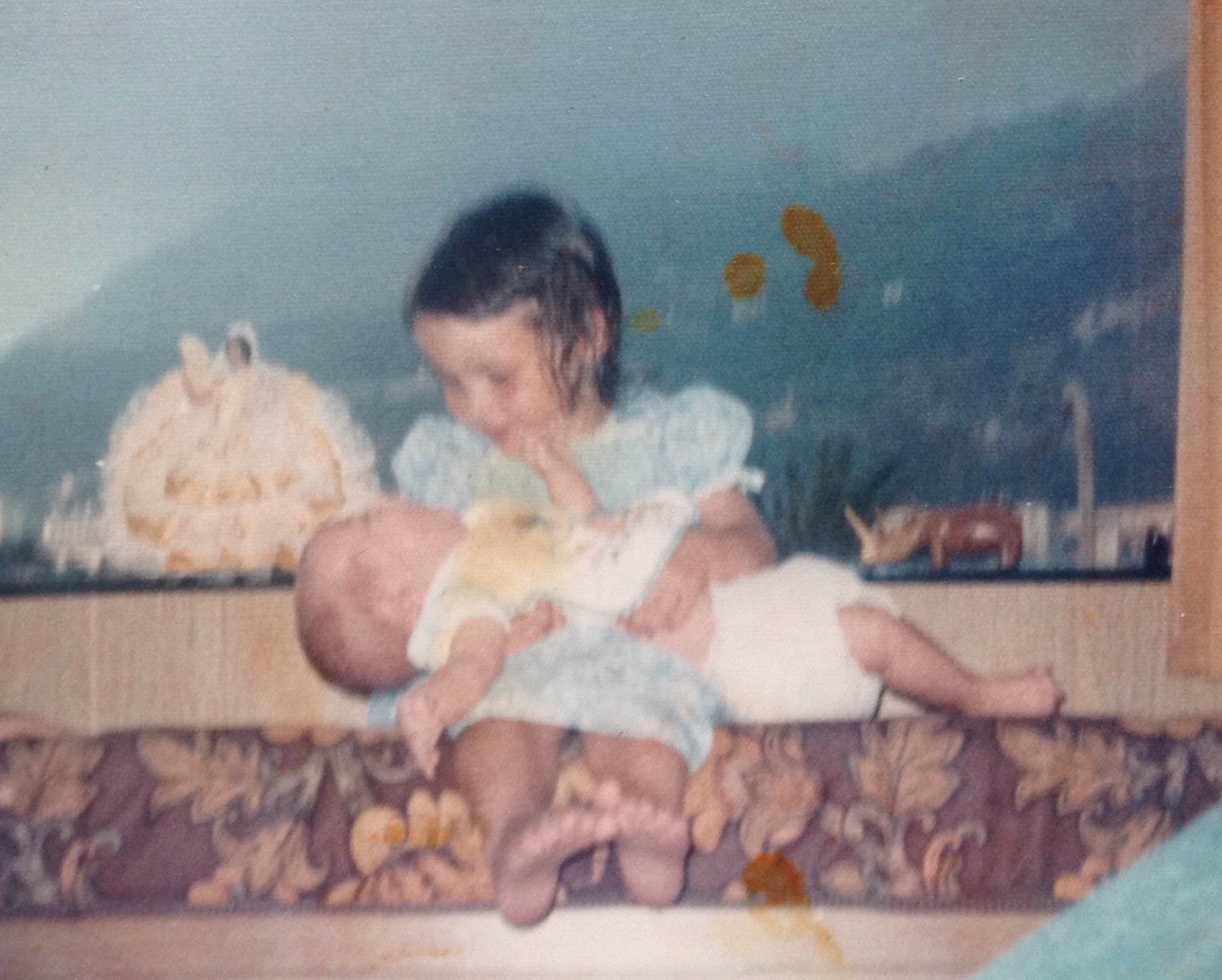
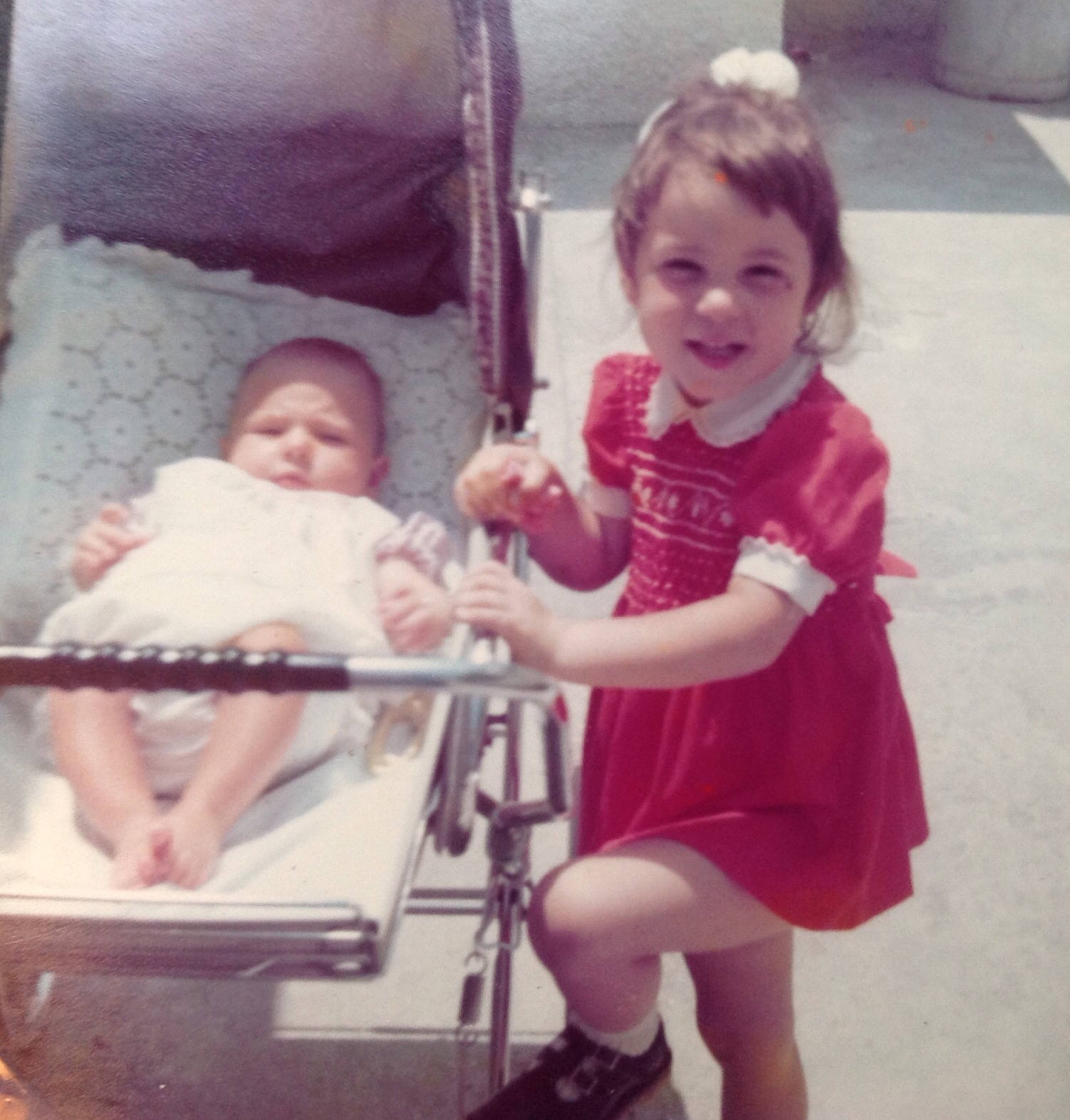
(Sisters xx Tracey with Sam. Top photo inside our caravan with the Rock out of the window).
*
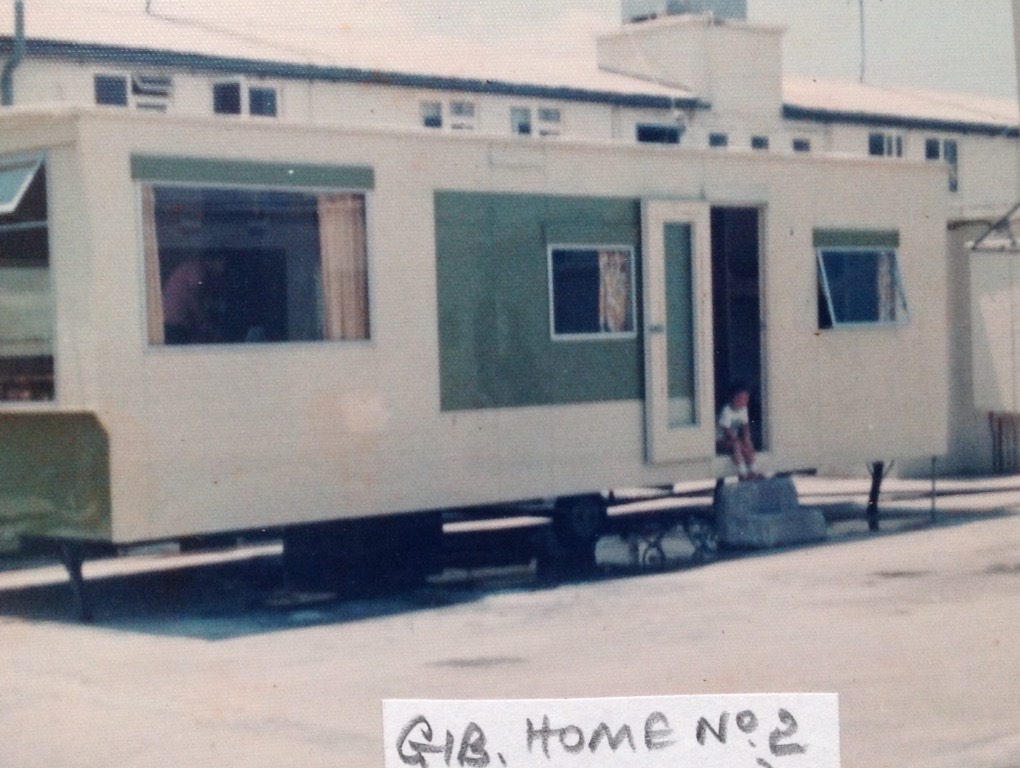
After a few weeks at Trafalgar House (I don’t remember exactly how many) we finally got the news that we had been allocated a Navy caravan and were thrilled; it was one stop away from a married quarter. The caravan site was situated on Queensway not far down from Rooke barracks and so it meant Carol was going to have far easier access to places – for example the NAAFI which was just up the road past Rooke opposite Edinburgh House. Recently when I was in Gibraltar I went searching for the old caravan site but I found a bus terminal had been built on the site.
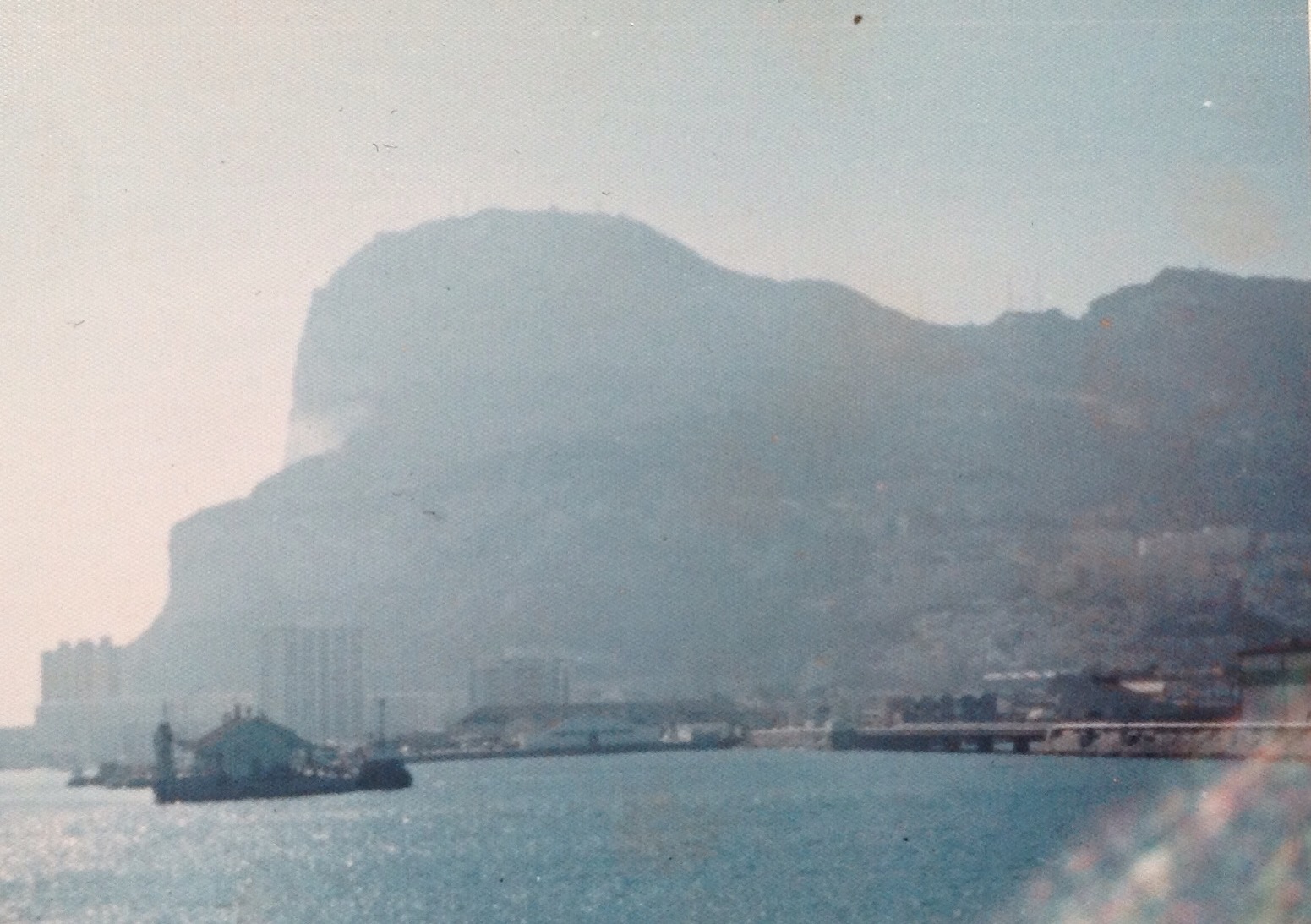
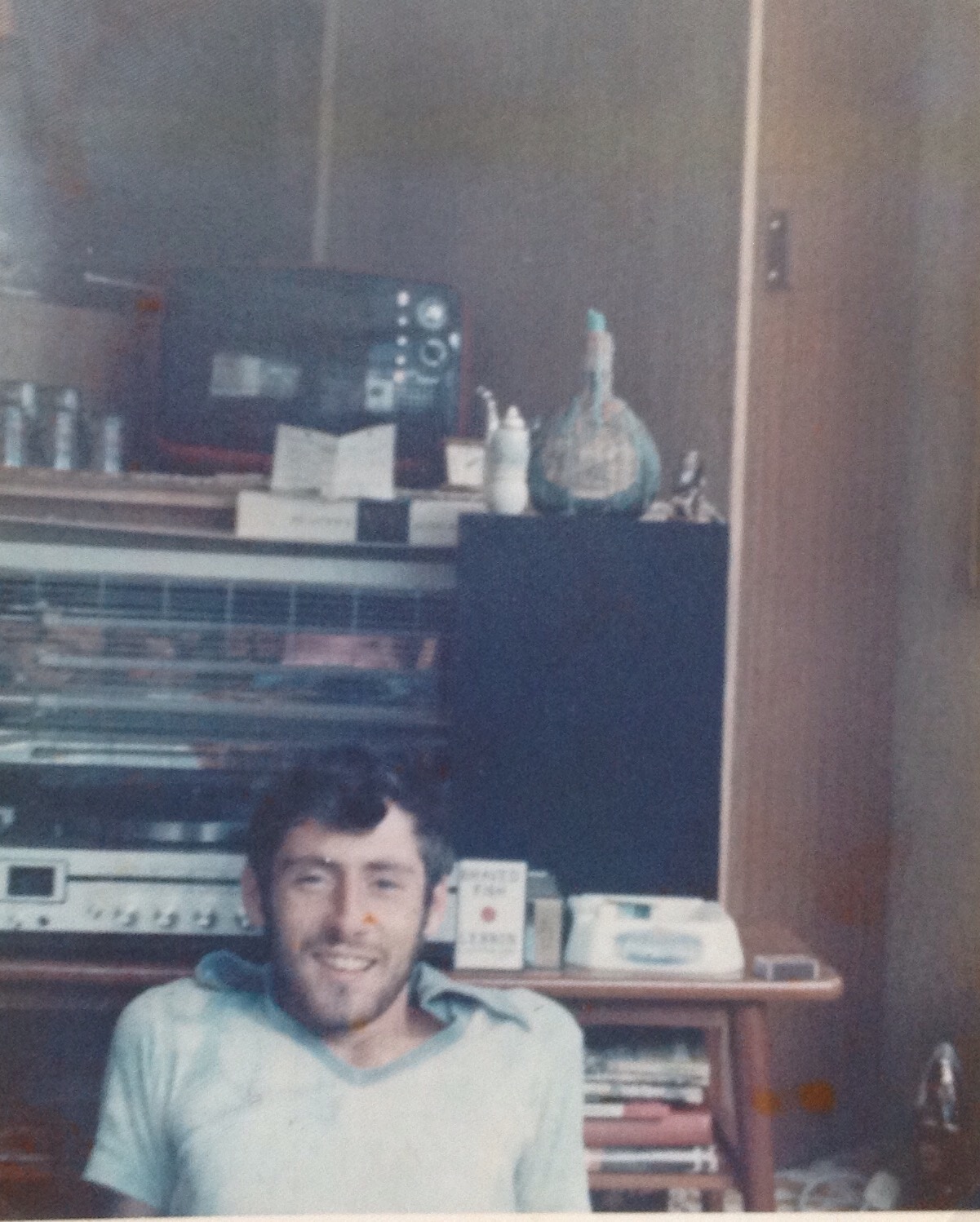
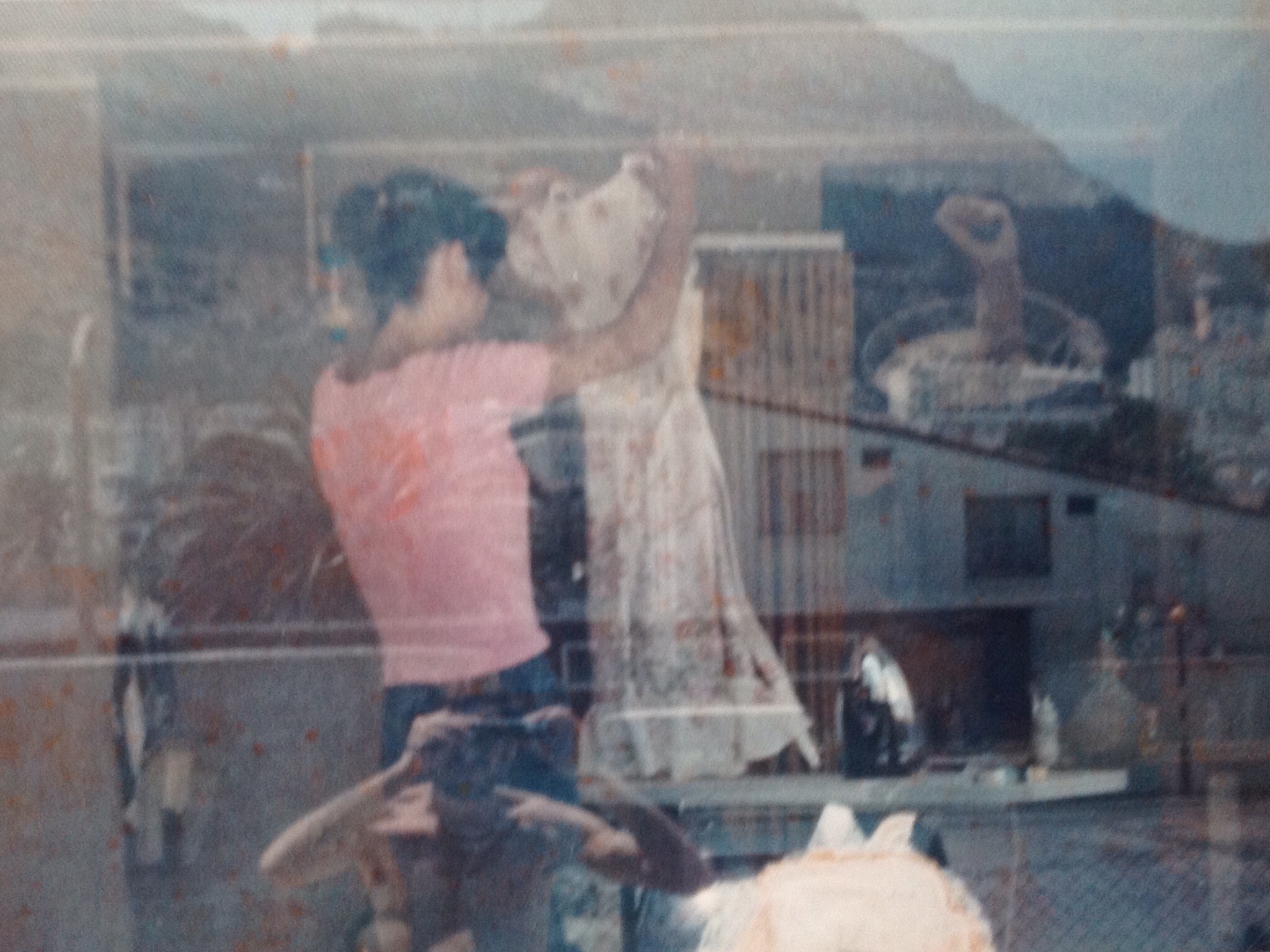
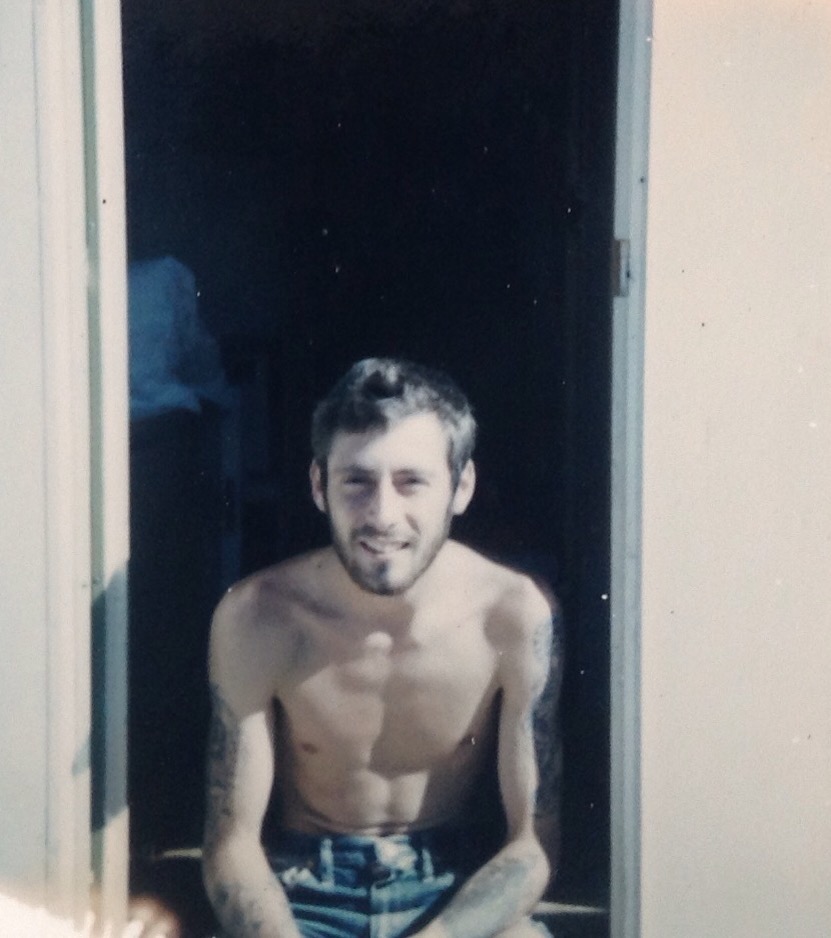
(Above are a few photos showing our life in the caravan. I loved the one I took from the outside looking in at Carol through the window that shows Carol folding a frock and me holding a camera in the reflection).
*
It was once we had moved onto Naval property that we finally started connecting with other Naval families and becoming part of a social network; I think living up at Trafalgar House had sort of stunted that. And life on the caravan site soon became a lovely ‘norm’ for us all; Tracey would play outside again and the view of the Rock from our lounge window was to die for. Life was good.
17 Friday Jun 2016
Posted in Gibraltar, Memoirs of Gibraltar, ROYAL NAVY
Younger readers might find it impossible to imagine life without instant and constant communication with their family, friends and loved ones but here we are talking 1976; there was no such thing as Internet or social networks, there was no such thing as emails or mobile phones. Phoning home meant standing in a queue outside a phone box with a load of coins in your hand hoping that the line was clear and the person you were calling was ready outside their phone box. 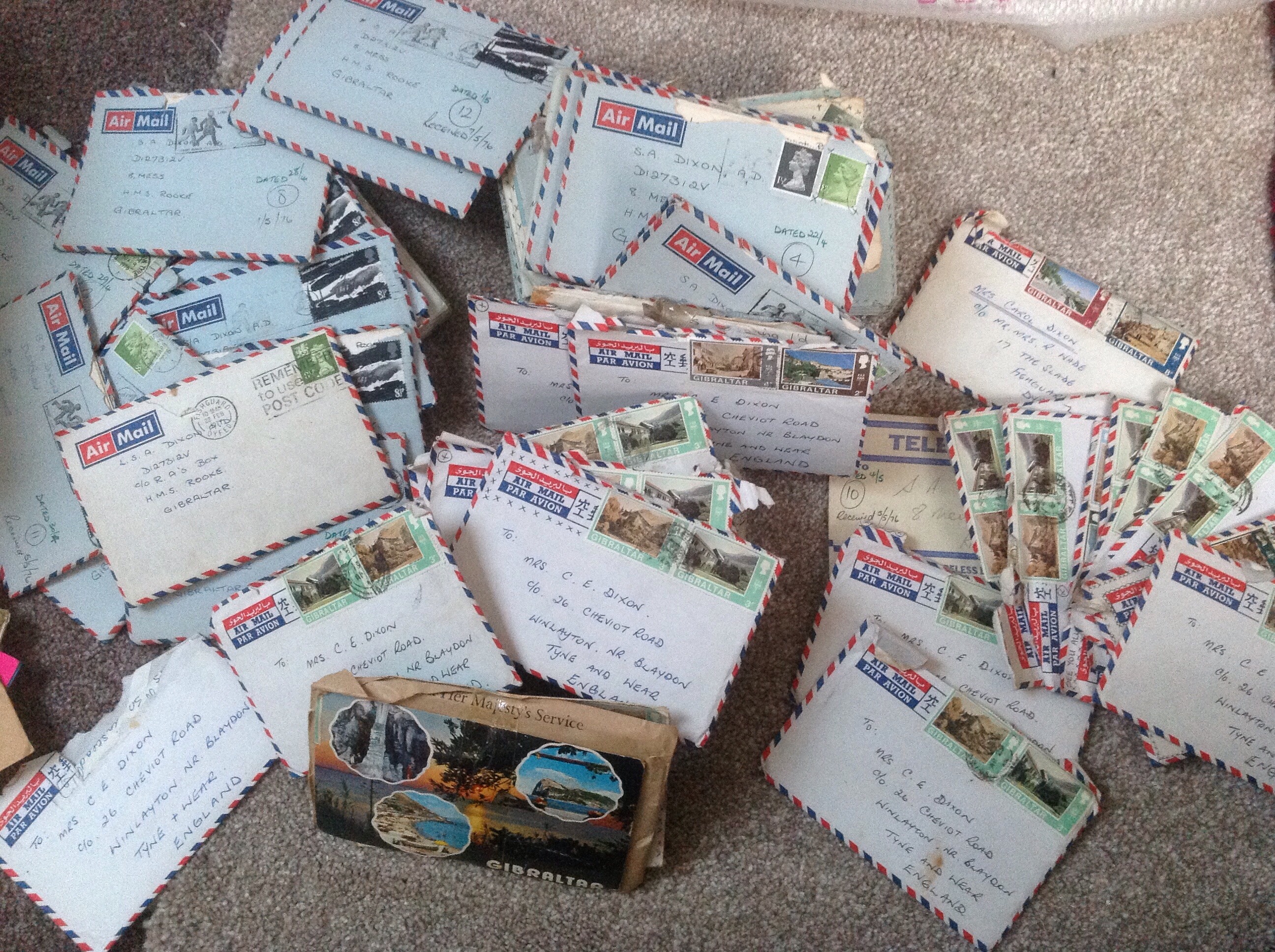
Phoning home from abroad could be an absolute nightmare and so the real deal was airmail. Writing letters and receiving replies is very much a dying art now and (in my humble opinion) a very big loss to the social fabric of life but back then it was a lifeline. To spend time and effort writing a letter to someone showed a real element of care for that person and the excitement of receiving a reply could never be understated, it was a clear message that someone cared equally about you. I guess still having all of my letters after 40 years and virtually none of my emails from yesterday says it all – and yes, I often read them 🙂
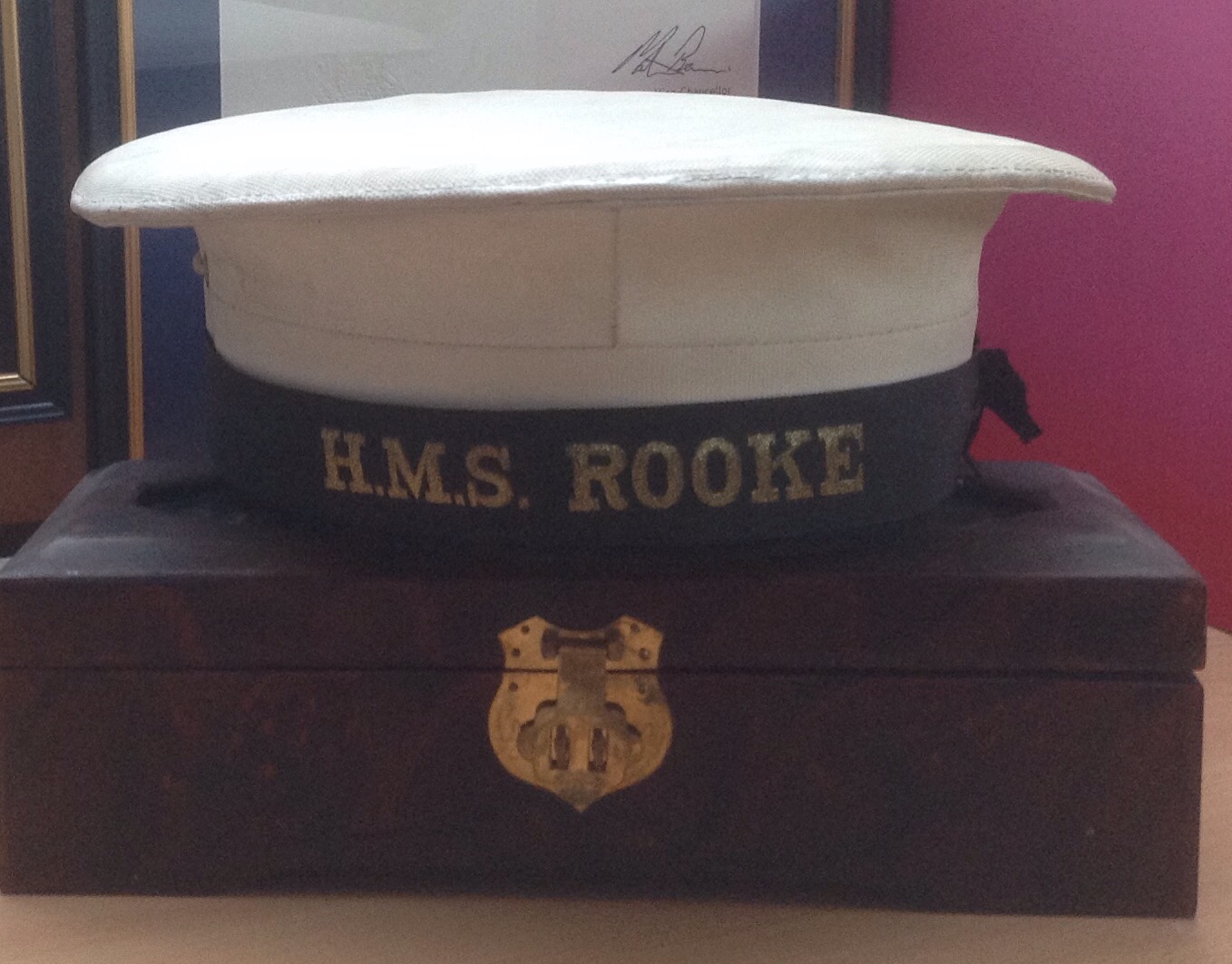
Although my highest personal priority was to find a flat and have it pass the inspection I also had a responsibility to my job in the Royal Navy. After posting my first letter home I immediately applied myself to my new role which was to die for; I was really proud to have my HMS Rooke cap tally (the photo is my actual cap). Readers will recall how (in Chapter 1) I envied the Stores Team working in Gibraltar as I watched them storing my ship (HMS Scylla) knowing I was leaving the Rock and now I was on that very team storing other people’s ships (I had to keep pinching myself to make sure I wasn’t dreaming). My job in a nut shell was receiving orders (known in the RN as ‘demands’) from warships due to dock at Gibraltar and make sure they were on the quayside when the ship arrived. Since some things had to be ordered from UK and other countries it was quite a challenging job but one with a great sense of satisfaction when it all went well. To not meet a ships ‘demands’ was not an option as it is always assumed that the ship could go to war at anytime and so whatever they wanted, they got.

(Above a stock photo)
Back in those days the Royal Navy was a lot bigger than it is now and many ships came through Gibraltar on their way out to the Far East or on their way back so our small team had to be very much on the ball – especially when the big boys (Ark Royal, Hermes) came through. To go back to that ‘nut shell’ I had the best job in the world, in the best place in the world and so was on top of the world – well nearly, but I would be when my family arrived 🙂
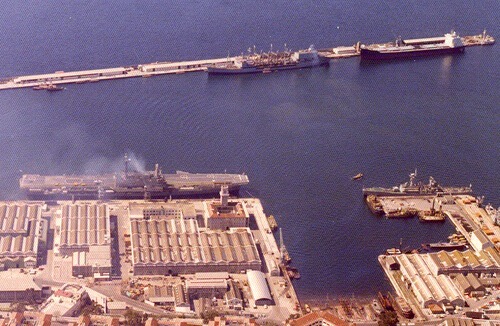
(Above a stock photo)
The Stores Office was the first building on the right as you passed through Rooke’s Main Gate and (as already mentioned) it was in there that I had my desk – the very same desk, in the very same office, now being sat at by a Gibraltar Police department policeman. Couldn’t make that up. Even just writing that put me right back there with Brian, Phil and Sandy; I pictured exactly where we all sat and even the photos we had on our desks. If the stupidest things make people emotional that sentence just did me.
13 Monday Jun 2016
Posted in Gibraltar, Memoirs of Gibraltar, ROYAL NAVY
Our house in Gosport was a private let owned by the Dame Elizabeth Kelly Trust which accommodated servicemen and their families who (for whatever reason) couldn’t get a married quarter. It was a small terraced house with a back garden that Tracey was able to play in safely and nearby was a park where we often took her.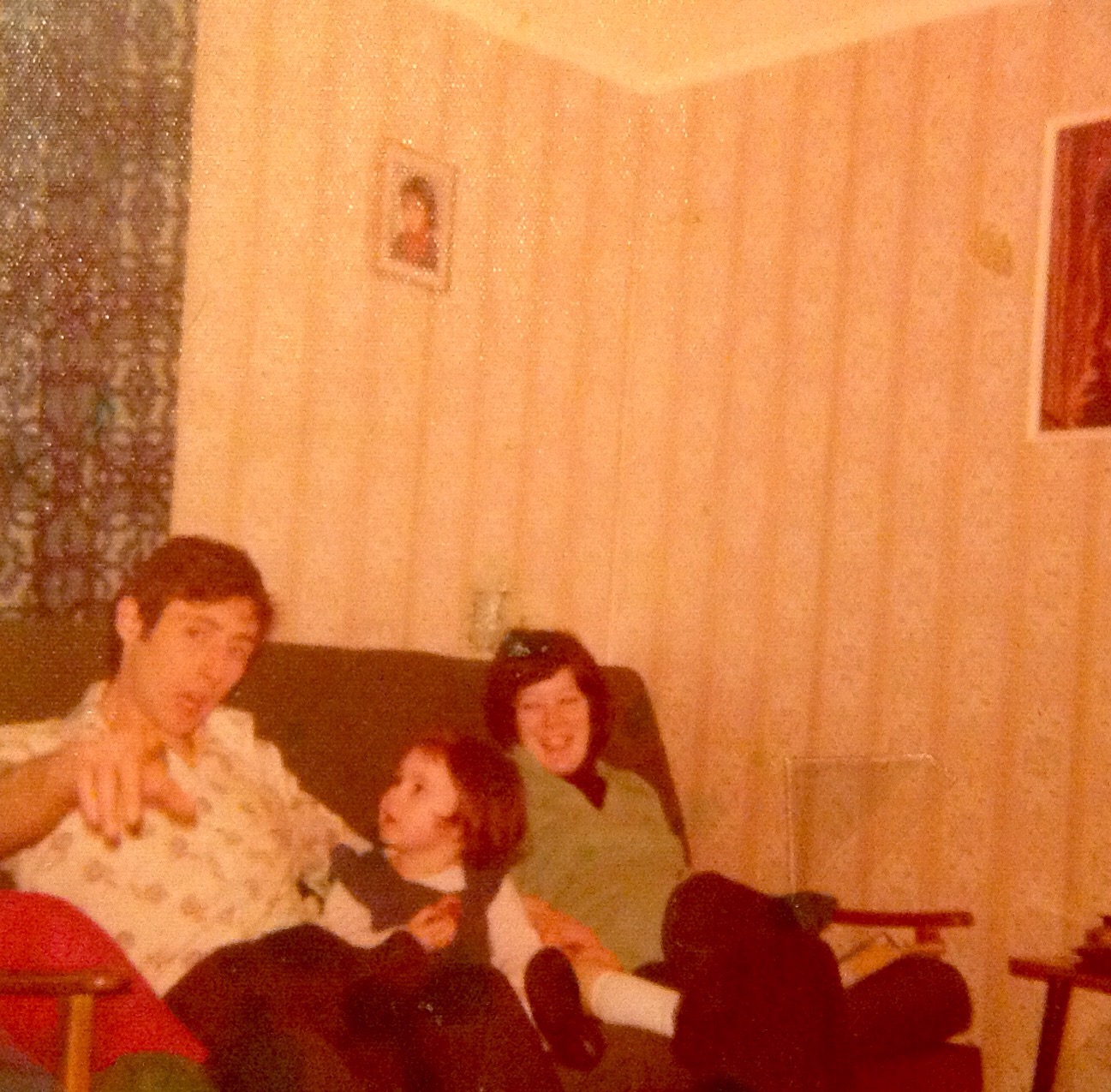
After Carol came home we needed to discuss and decide where she and the children would stay until I got a Family Passage (FamPass) and it wasn’t easy; I had to know they were safe and would be looked after but at the same time had no choice but to consider cost. Eventually it was agreed they would stay with my sister Kerrie and her husband Graham in Newcastle; of all of my three sisters Kerrie was the one I was closest to and she was also very laid back which I thought would be good for Carol and the children. Kerrie lived in Rowlands Gill in the same house she had been brought up in as a child. Her husband Graham could appear loud at times but Carol would find that during her stay there he was an absolute diamond whenever problems arose.
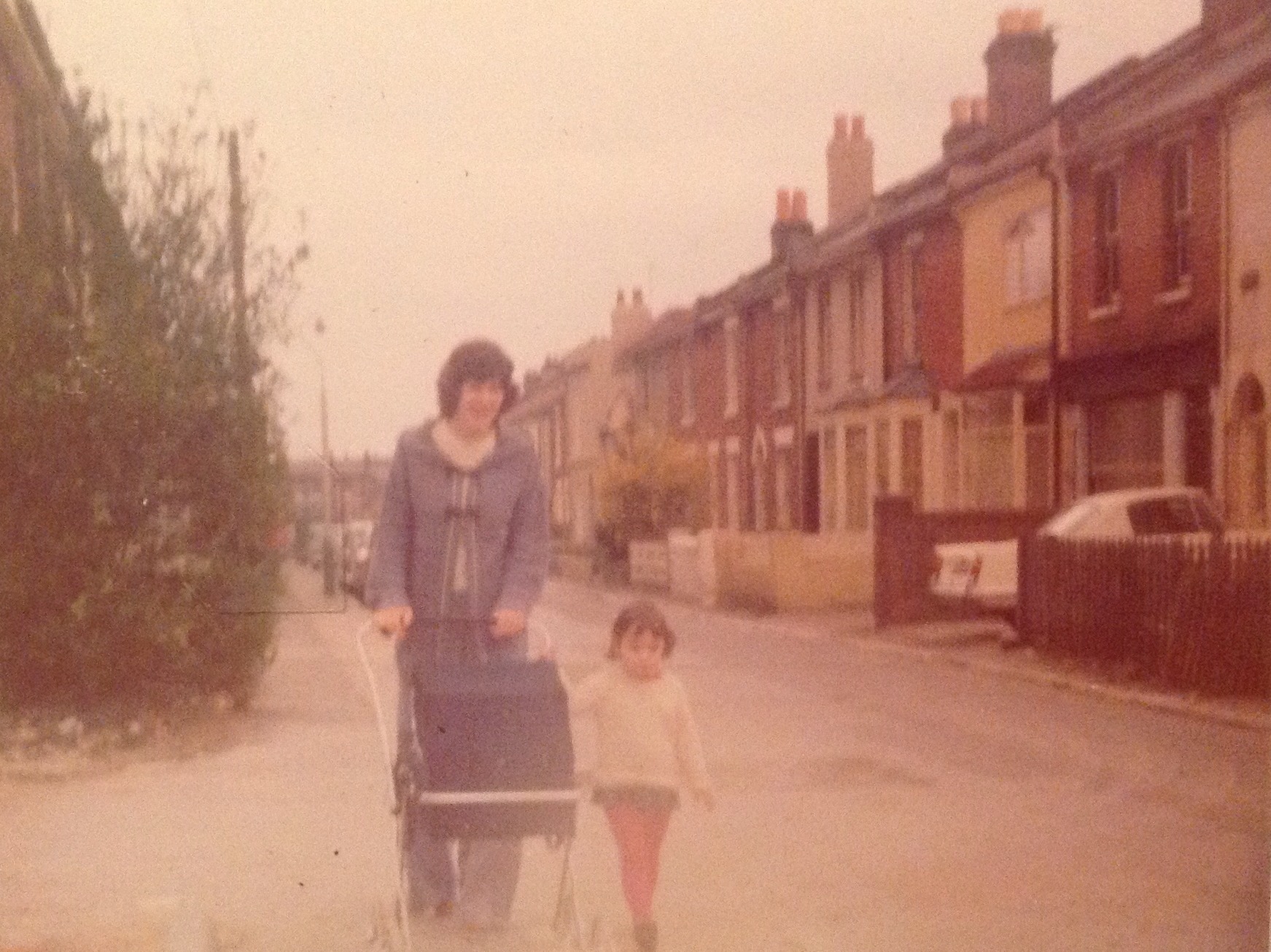
Meanwhile in Gosport we had a few days to kill before giving in the house keys and going North during which we made a big fuss of Tracey as she got know her new sister; Carol encouraged her to help her tend Sam’s needs, getting clothes and nappies ready or joining her for a walk while I gave her loads of praise for being a brilliant big sister.
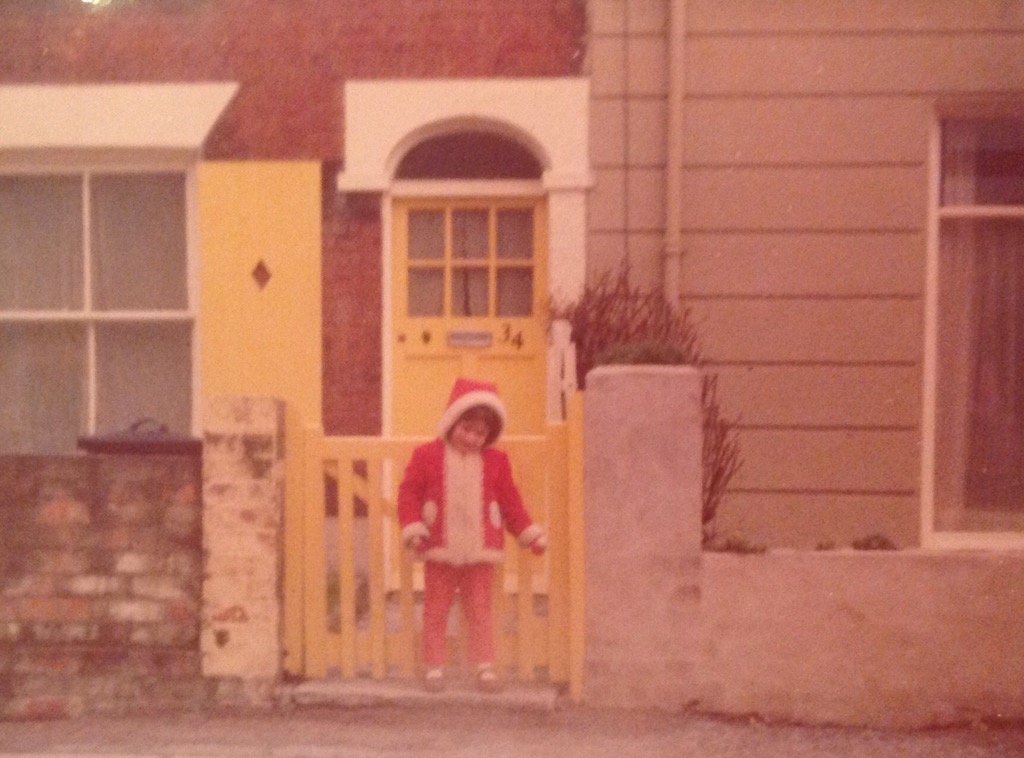
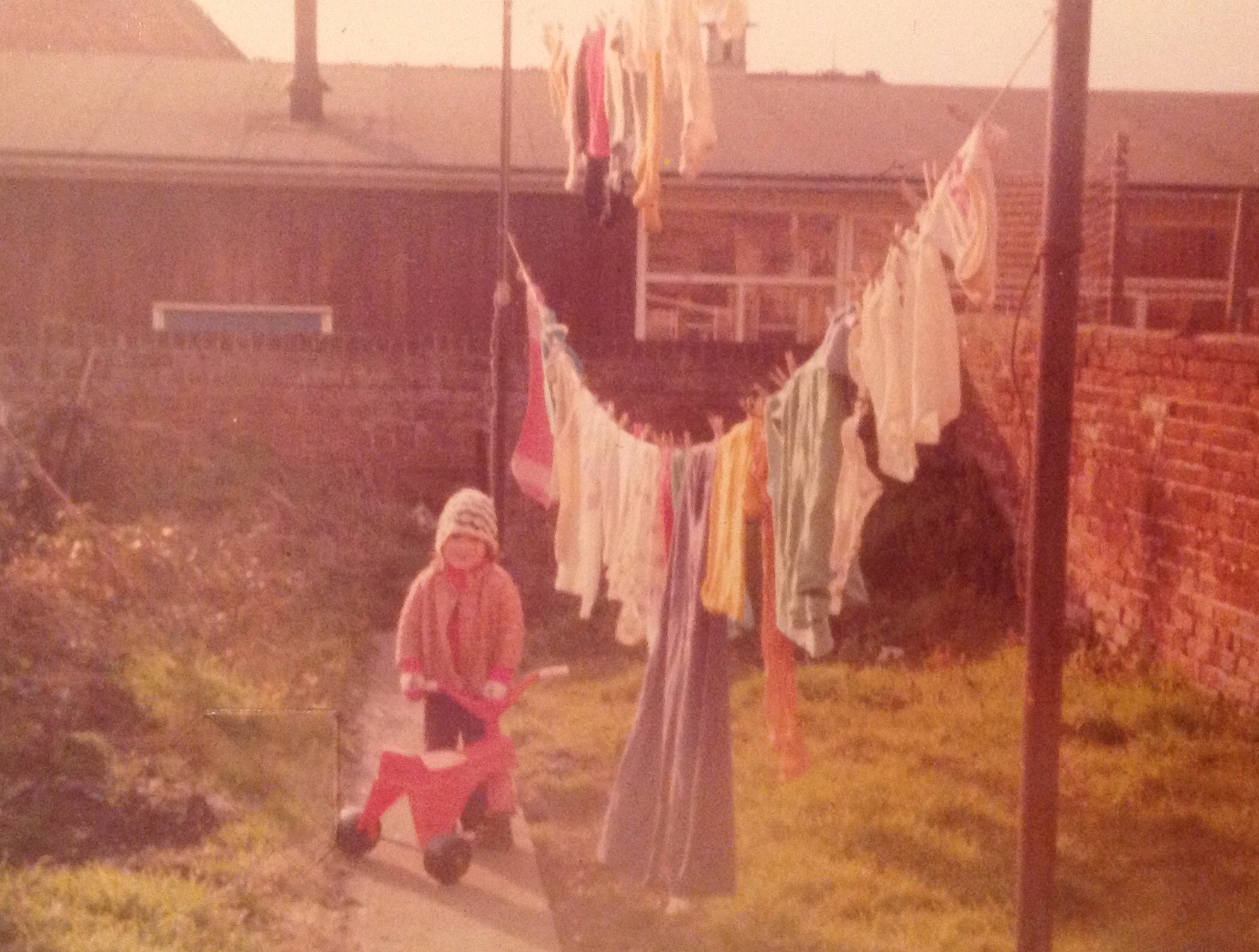
It’s difficult to put into words the mixture of anxiety and excitement we both felt knowing that our lives would be changing in less than a week when I would fly to Gibraltar not knowing when my family would follow; life was very surreal as we continued with normal things.
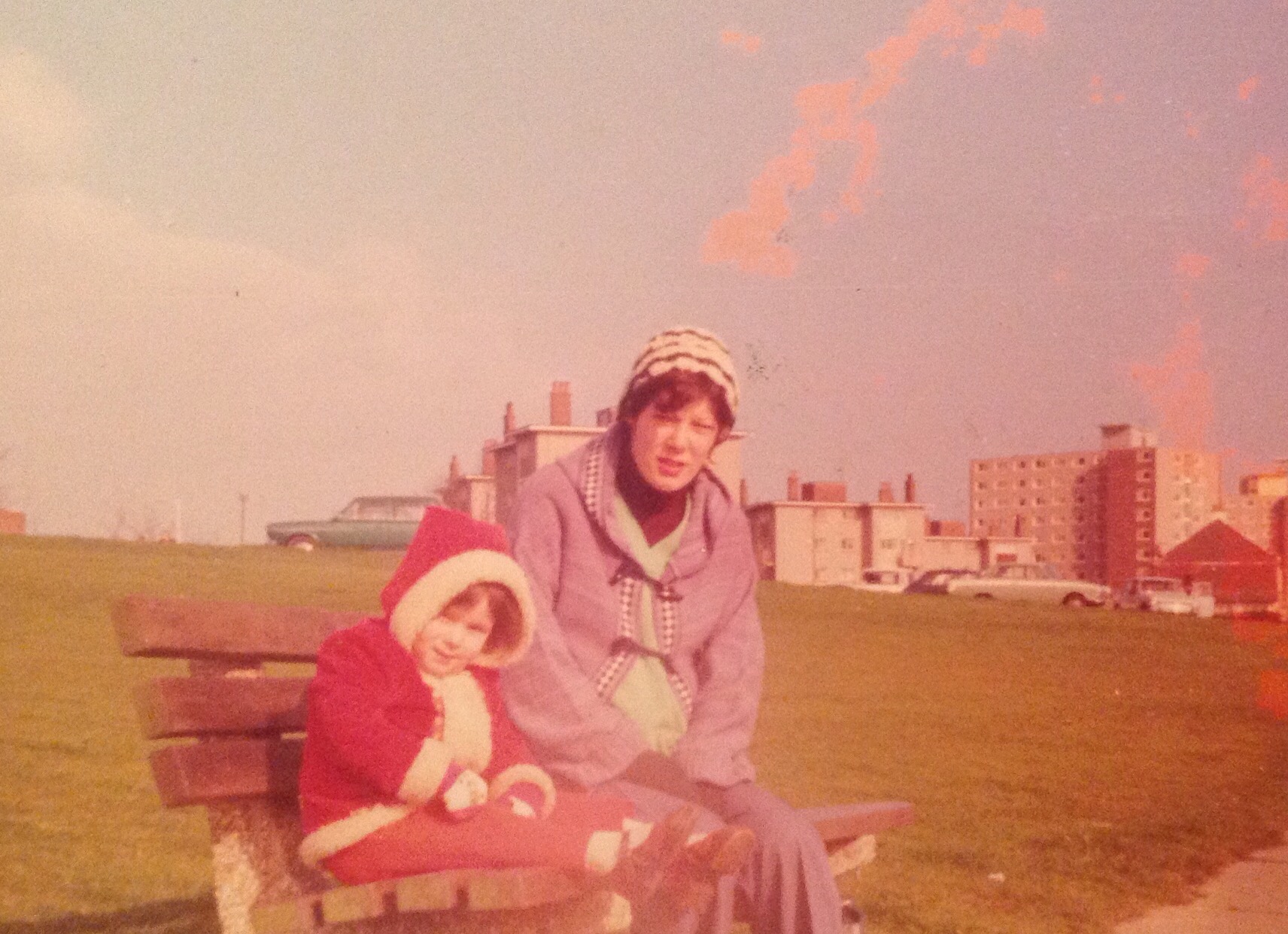
One of the hardest things for me was Tracey’s bedtime routine, particularly reading her story and knowing that next week I couldn’t and didn’t even know when I could again. (*That particular thought came to me ‘this very evening 13/6/2016’ as I was reading my granddaughter Rhiannon, age 8, her bedtime story – Jungle Book); memories for me are far more powerful than words.
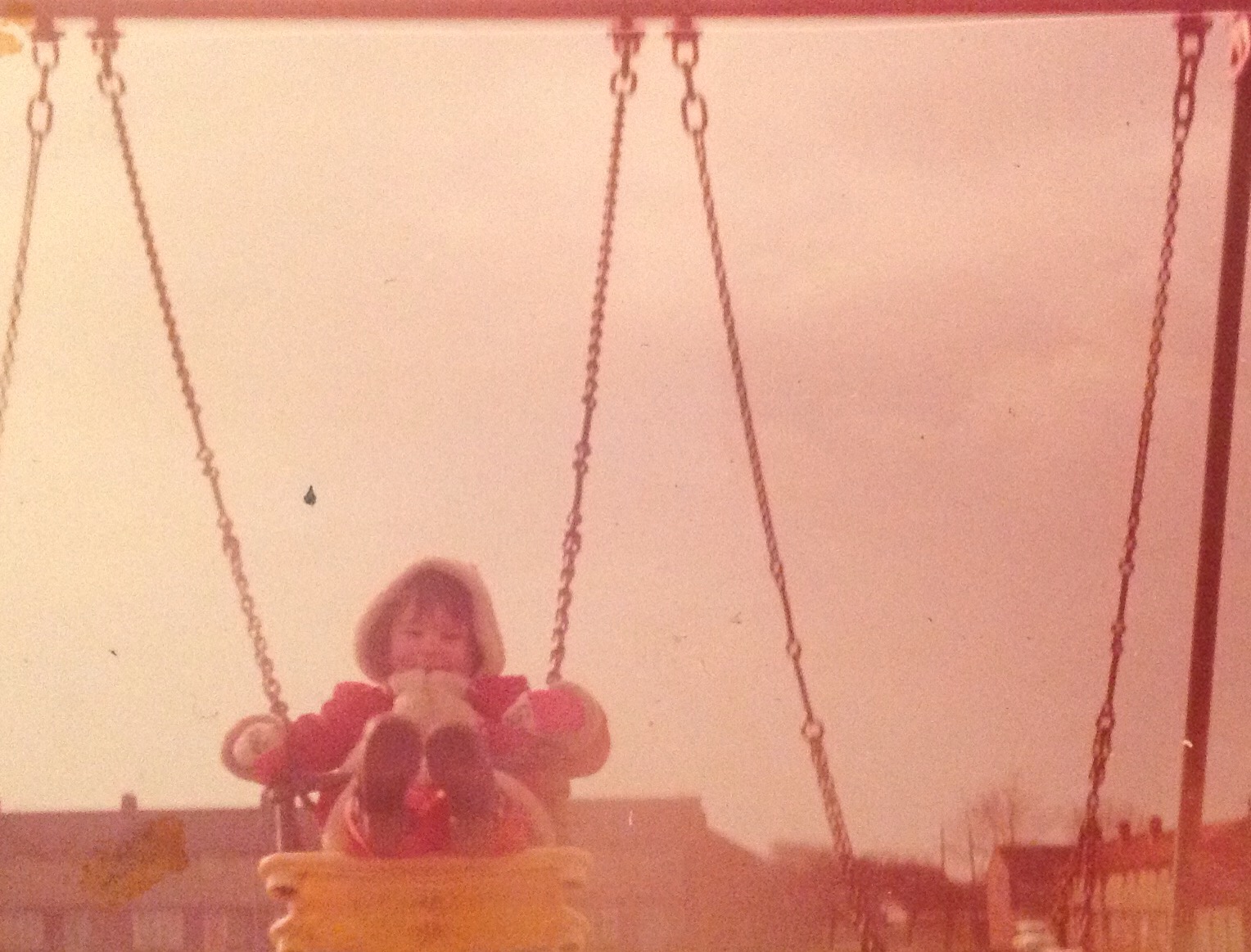
As I look at these (fabulously, yellowy, organic) old photos of those days I’m right back there; I can feel the tension but more importantly I can feel the love and I treasure that. I don’t remember which story I read to Tracey on our last night in Gosport but I do know how I felt when I read it. At the end of the story I kissed her goodnight and said “Tomorrow sweetheart we’re going to see Auntie Kerrie X “.
29 Sunday May 2016
Posted in Gibraltar, ROYAL NAVY
Tags
On the 8 January 1974 HMS Scylla led the 7th Frigate Squadron, eight ships in total, out of Portsmouth harbour for what was to be a nine month deployment to the Far East. It was a very emotional departure for most of the sailors as hundreds of families were lined up on the jetty’s and quaysides waving them off to the dulcet sounds of the Royal Marines band. Having already bid my elderly foster parents ‘bye at New Year I didn’t have that lump in my throat like many of the others but I was still amazed at how many people had come to see us off; from standing to attention on the upper deck all I could see was a human caterpillar stretching miles along the Hampshire coast.
Before long we were out at sea, out of vision and so changed into workwear to assume our normal sea going duties. I knew the (English) Channel and the Bay (of Biscay) had reputations of rough weather but after two months surviving the Gale Force storms of Iceland I wasn’t too concerned. Having said that the seas were rough and there were times I felt really sick but stayed focused thinking it wasn’t going to be for long.
As a Stores Accountant most of my time at sea was spent ‘down below’ either in the stores office or in one of our storerooms and so I had to keep nipping up onto the upper deck to see where we were; I didn’t want to miss our approach to Gibraltar. Many of the lads onboard had been in the Navy far longer than me and had visited all of the usual ports on many occasions, including Gibraltar. Their conversations seemed to revolve around the fact that Gibraltar had 365 pubs, one for every day of the year, and that their sole aim during our brief visit was to get ‘mortal’, ‘marinated’ or ‘steaming’ depending on what part of the U.K. they were from. Whether Gibraltar does have or ever has had 365 pubs I don’t know but visiting any of them wasn’t on my itinerary. I was only18 and not a particularly big drinker at that time; on top of that I was more interested in seeing real apes than men mimicking them drunk. I’d seen enough of that with my foster dad rolling home (see Memoirs of a Child in Care).
Years later, when living in Gibraltar with my family, I recall whenever ships were in port we didn’t go anywhere that sailors may happen to be, in fact we positively avoided those places but then that’s another story and a tale for Chapter 2.
I don’t remember the exact date we arrived at the Rock other than it was in January but there’s a guy who owns a shop in Gibraltar (opposite John Mackintosh Hall) selling photos of Royal Navy warships would probably know for sure. What I do know is the minute that someone spotted the Rock from several (nautical) miles away my eyes were glued to it; and the nearer we got the less I blinked not wanting to miss a moment of our arrival (or end the awe I was feeling).

As we berthed alongside I looked up at this massive Mediterranean lump of Britain in the sun and knew then Gibraltar would become very special to me.
28 Saturday May 2016
Posted in Gibraltar, ICELANDIC CONFLICT, ROYAL NAVY
Tags
It was January 1974 and I was serving aboard HMS Scylla (F71), Flagship of the 7th Frigate Squadron. By then I’d been in the Royal Navy for about two and a half years and had served on Scylla for the previous 13 months.
During 1973, following a major refit, Scylla had been on work-up and trials at Portland which was pretty draining for the crew. It was the Royal Navy’s way of putting a warship through its paces to check its systems, weaponry and crew readiness – ensuring (to put it bluntly) that it was ready for war. Some of the exercises went on for hours and hours and necessitated men having to wear additional heavy clothing, head gear or masks and remain at ‘action stations’ for very long periods of time; needless to say we were all glad when it was over. It wasn’t too long though before we were rewarded with a couple of courtesy visits to Brest (France) and Flensburg (Germany) prior to escorting HM Queen Elizabeth aboard HM Royal Yacht Britannia around Scotland.
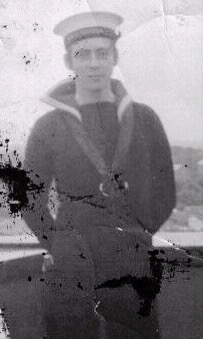 Flensburg, Germany 1973
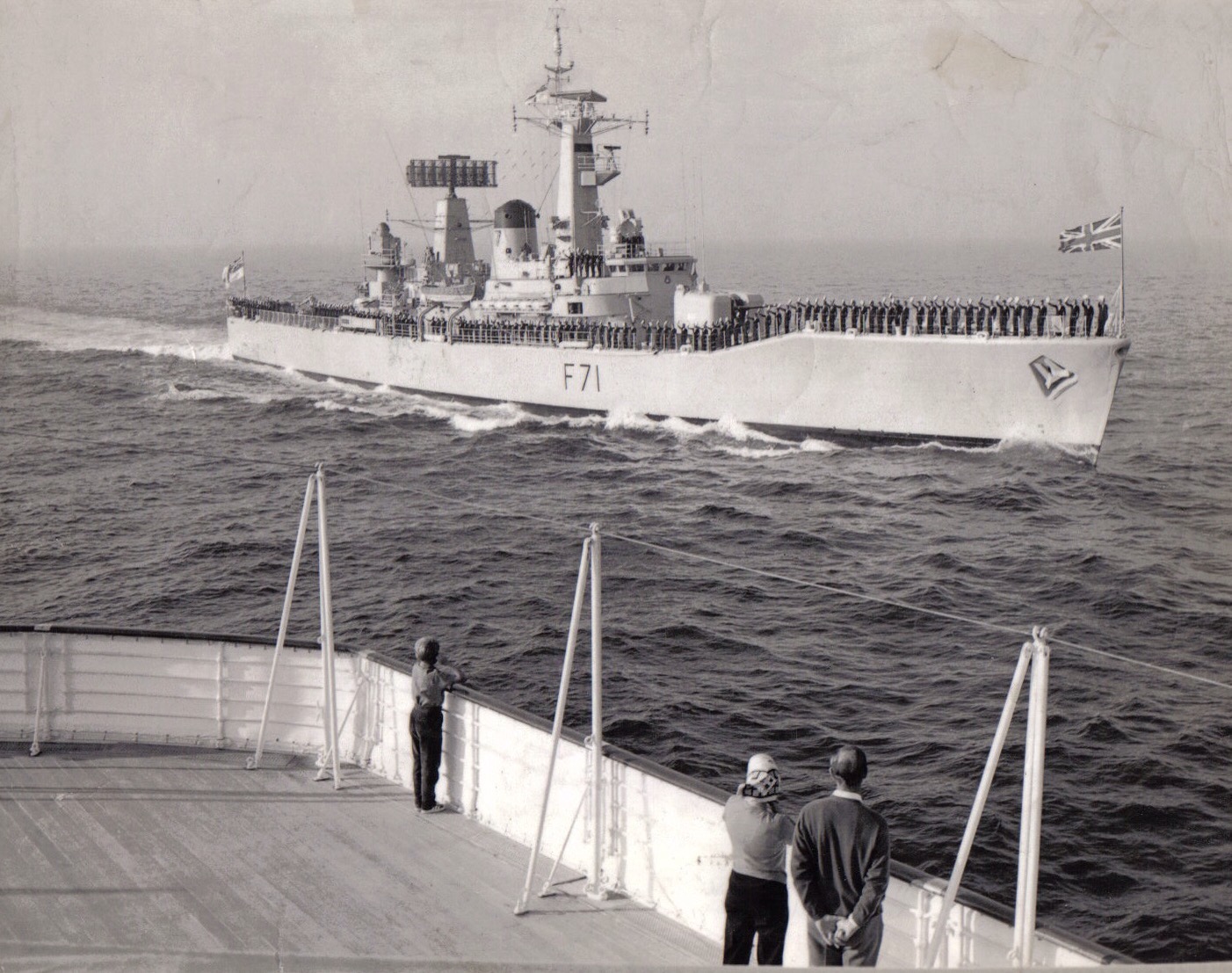
Escorting HM Royal Yacht Brittania. The Queen and Duke in the foreground, Prince Andrew watching.
Significantly that year we had also taken part in (what later would be referred to as) the Icelandic Cod War during which we had been rammed by the Icelandic Gunboat Aegir. The Icelanders only had five gunboats which were small compared to a Leander Class Frigate but were all fitted with ice breakers capable of causing serious ruptures. Although we had sustained damage the affected compartments were shored up and we continued then completed our tour of duty regardless.

HMS Scylla during the Icelandic conflict
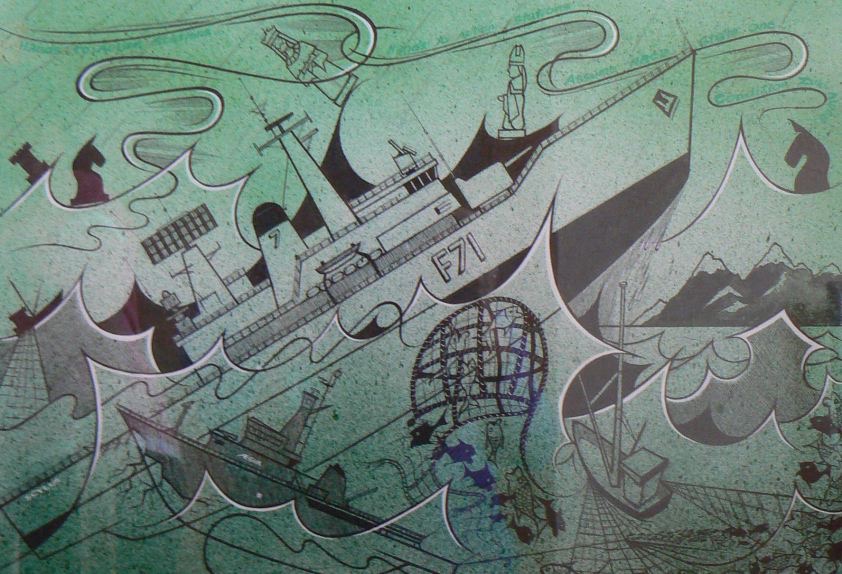
My Ink Painting of the Icelandic conflict
Sometime in the autumn of ’73 news of our next deployment came through and all-to-a-man were delighted to hear we were finally off to see some sunshine, particularly after the drain of Portland Trials and the chills and gale force storms of Iceland. Come January ’74 Scylla was to lead a deployment of 6 warships and 2 RFAs (Royal Fleet Auxiliaries) out to the ‘Fez’ (Far East) calling at an amazing selection of places including Sierra Leone, South Africa, Mombasa, the Gulf, Singapore, Hong Kong, Bangkok, Australia and New Zealand.
Particularly exciting for me was the very first (and very last) stop on this fabulous trip – Gibraltar; that big Rock where the apes lived. I screamed inside with delight, then phoned my cousin Paul.
 RockHeart